TL;DR
A Fit&Well report featuring trainer Kylie Hansen argues that women in midlife should pay attention to power as well as strength. It describes power as producing force quickly and offers four adaptable exercises, but the source does not provide research findings or evidence that this specific routine improves longevity.
Fit&Well has published a workout guide urging women in midlife to train exercise power—the ability to produce force quickly—as well as strength. The report features Kylie Hansen, a NASM-certified personal trainer, who recommends three adaptable movements for practicing rapid force production and a fourth exercise to train core stability; the source does not present evidence that this routine itself extends lifespan.
Hansen describes power as using strength at speed. She says the skill can help with rapid actions such as catching oneself after a trip or moving to regain balance. According to her, muscle fibers involved in quick, powerful movements can decline with age and inactivity. Those statements explain the rationale offered in the report; it does not include study results or quantify the rate of decline.
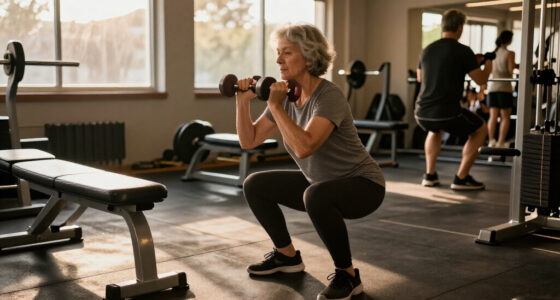
The suggested workout includes burpees, squat jumps and a squat to upright row, alongside plank dumbbell pull-throughs. Hansen advises doing two or three sets of each movement, with five or six repetitions per set for the first three exercises and five or six per side for the pull-through. The guide recommends resting 60 to 90 seconds between sets.
The movements can be adjusted: a burpee can be stepped through instead of jumped, a squat jump can be replaced by rising onto the toes, and the plank pull-through can be done from the knees. Hansen says to prioritize controlled, purposeful repetitions rather than continuing until exhausted. The report presents this as practical training advice, not a clinical prescription or a tested program with stated outcomes.
Why Fast Force Matters in Daily Movement
Power is relevant to everyday movements that require a quick response, including recovering balance after a stumble. The report’s point is that training strength alone may not address the speed component of movement. For readers choosing exercises, that distinction offers another way to think about physical fitness as they age: strength and rapid force production are related but not identical.
The article frames power as important to longevity, but its supplied material does not establish that the four-move workout increases lifespan or prevents falls. Its more specific, supportable takeaway is that Hansen sees controlled power practice as a way to work on movements that call for speed and coordination. Beginners can use the suggested modifications rather than starting with jumps or complex lifts.
How the Four-Move Routine Is Structured
The report builds on commonly discussed advice to maintain strength with age, then focuses on power as a skill it says receives less attention. Hansen’s examples are intended to make the distinction concrete: a squat jump asks someone to produce force quickly, while the squat-to-row combines upper- and lower-body movement. The plank pull-through is different from the explosive exercises; it challenges the person to stabilize the body as support shifts.
Hansen recommends keeping the work brief and allowing rest between sets because, she says, power declines as fatigue builds. She favors a small number of crisp repetitions over turning the routine into a high-repetition cardio session. The source provides exercise instructions and modifications but no comparison with other programs, participant results, or duration for following the workout.
“Power drops as fatigue builds.”
— Kylie Hansen
What the Report Does Not Establish
The source does not identify a study showing that this workout improves longevity, prevents falls or produces a particular health outcome. It also provides no publication date, research citations, or information about how the routine was evaluated. Hansen’s statements about age-related changes are attributed expert guidance in the report, rather than findings quantified there.
Readers’ suitability for jumping, lifting weights or performing plank exercises will vary. The guide offers easier versions, but does not give individualized advice for people with injuries, balance problems or health conditions. It does not specify how often to do the routine, how to increase difficulty over time, or how to combine it with other training.
How Readers Can Apply the Advice
The source offers no announced follow-up study or program update. Its immediate guidance is to choose modifications that allow controlled movement, keep repetitions crisp and rest between sets. People new to exercise can start with lower-impact versions and seek guidance from a qualified coach or health professional if they are unsure which movements are appropriate, particularly if they have a health condition or injury.
Any stronger claim about longevity would require evidence beyond the workout instructions in this report. For now, the article is best read as trainer-led exercise guidance about practicing power and stability, not proof of a lifespan benefit.
Key Questions
What does exercise power mean?
In Hansen’s description, power is the ability to produce force quickly—using strength at speed, such as when moving to recover balance.
Which exercises does the report recommend?
The workout lists burpees, squat jumps and squat-to-upright rows, followed by plank dumbbell pull-throughs to challenge core stability.
How many sets and repetitions does it suggest?
The guide recommends two or three sets, five or six repetitions for each of the first three movements, and five or six pull-throughs per side, with 60 to 90 seconds of rest between sets.
Can beginners adapt the exercises?
Yes. The report suggests stepping through burpees, rising onto the toes instead of jumping, and performing the plank pull-through from the knees. Hansen advises using modifications that allow controlled, purposeful movement.
Does this workout prove power training extends lifespan?
No. The source describes power as relevant to movement and presents a trainer’s exercise recommendations, but it does not provide evidence that this routine extends lifespan or prevents falls.
Source: rss