
TL;DR

Get sports gear delivered free with Prime
- Fast, free delivery on millions of items
- Prime Video, Amazon Music and more included
- Member-only deals all year
A trainer who works with older adults says she includes three coordination exercises in chair-based yoga and personal training: opposite arm-and-knee raises, side steps with an opposite-arm reach, and a ball-catching drill. A cited 2019 review reported improvements in some cognitive and balance-related outcomes, but the source does not provide specific study details or evidence that these exercises extend lifespan.
A trainer who works with older adults says she includes three coordination exercises in her chair-based yoga classes and personal training sessions, offering standing and seated variations. The Fit&Well report describes the movements as a way to practise coordinating limbs and responding to movement; it does not establish that the exercises extend lifespan or prevent falls.
The exercises are a knee raise paired with the opposite arm, a side step paired with an opposite-arm reach, and a catch-and-throw drill. For the first movement, the trainer recommends raising one knee while moving the opposite arm, then alternating sides for five or six repetitions each. The standing version uses an upright posture and controlled movements; the seated alternative is a slow march with the opposite arm raised.
For the second exercise, participants step to the side and reach the opposite arm forward. They can keep the movement upright or add a side lunge if comfortable. The report suggests five or six repetitions on each side. Seated participants can step one foot out and open the opposite arm to the side. In both versions, the movements can be kept small and controlled.
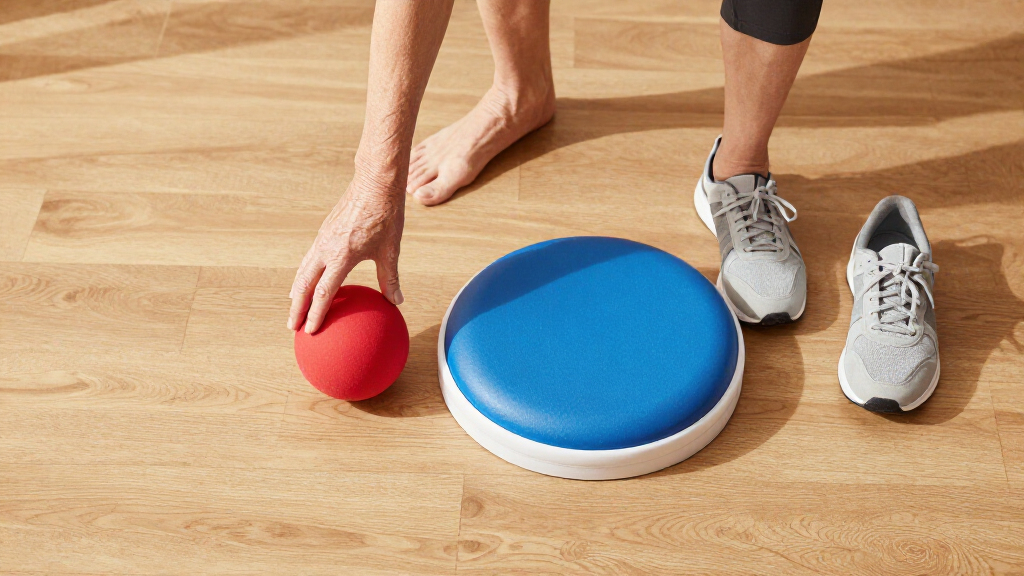
The third exercise uses a ball and a wall. A participant stands a few steps away, balances on one leg, tosses the ball underhand so it bounces lightly off the wall, and catches it. The report suggests five to 10 repetitions. It describes adjustments including standing on both feet, doing the activity seated, using one or two hands, and changing the ball’s size or the direction of the throw.
Practising Movement in Daily Life
The trainer presents coordination work as practice for combining movements and responding to what is happening around a person. That focus may be relevant to everyday activities that involve moving while paying attention to other people or tasks. These are the trainer’s reasons for including the exercises; the report does not measure whether participants become more confident or agile, or whether the drills reduce falls.
The suggested seated versions also make the activities adaptable across different mobility levels. That flexibility matters because a standing balance drill may not be suitable for everyone. The source recommends adapting the movements, but it does not provide an individual assessment or a detailed safety protocol. People with health concerns or difficulty balancing may need guidance from a qualified clinician or exercise professional before trying them.
lightweight soft exercise ball for seniors coordination training
As an affiliate, we earn on qualifying purchases.
As an affiliate, we earn on qualifying purchases.
How the Report Frames Coordination
The report notes that strength training is often discussed in connection with ageing well, while arguing that it is not the only kind of exercise worth considering. The trainer says she incorporates coordination work into her sessions to practise what she calls the mind-to-muscle connection. Her examples range from simple arm-and-leg patterns to a ball drill that involves reacting to a moving object.
Fit&Well refers to a 2019 review of balance and coordination exercises in older adults. According to the report, the review found improvements in cognitive processes such as spatial awareness, as well as postural control and stability in distracting environments. The source material does not name the review, give its sample size or describe the exercises and measurement methods. It therefore supports reporting the finding as summarized by Fit&Well, not making broader claims about clinical outcomes.
“I always incorporate coordination training into my chair-based yoga classes and personal training sessions with older adults”
— The trainer quoted in Fit&Well
stable chair with arms for seated exercises seniors
As an affiliate, we earn on qualifying purchases.
As an affiliate, we earn on qualifying purchases.
Limits of the Available Evidence
The source material does not identify the trainer by name or provide the date of the Fit&Well article. It also does not include the 2019 review’s title, authors, study population or numerical results, making it difficult to assess the scope of the evidence from this report alone.
There is no information about how often the trainer’s clients perform the drills, how their progress is measured, or whether the exercises affect falls, independence or longevity. The article presents a trainer’s account and exercise instructions, not a controlled trial. Individual capacity and safety needs are also not discussed in detail, so the examples should not be treated as a tailored programme.
non-slip exercise mat for balance exercises
As an affiliate, we earn on qualifying purchases.
As an affiliate, we earn on qualifying purchases.
Adapting the Drills Safely
The report does not announce a follow-up study or a new programme. Its practical next step for readers is to choose a version that matches their current mobility: use a chair for the marching and side-step patterns, or reduce the balance challenge in the ball exercise by keeping both feet on the ground. The suggested repetitions are modest starting amounts, not a prescription for every person.
Readers interested in adding coordination exercises can ask a qualified exercise professional or healthcare provider how to adapt them, particularly if they have balance problems, pain or a condition affecting movement. The source does not say whether the trainer or Fit&Well plans further reporting, and no additional research milestone is given.
lightweight foam ball for wall toss and catch exercises
As an affiliate, we earn on qualifying purchases.
As an affiliate, we earn on qualifying purchases.
Key Questions
Which three coordination exercises does the report describe?
They are an opposite-arm knee raise, a side step paired with an opposite-arm reach, and a ball toss-and-catch while balancing. The report gives both standing and seated options for the first two, and easier versions of the ball drill.
Can the exercises be done seated?
Yes. The report suggests a controlled seated march with the opposite arm raised, a seated side step with the opposite arm opening out, and performing the ball activity while seated. People should choose movements suited to their abilities.
What does the report say the research found?
Fit&Well summarizes a 2019 review as finding improvements in spatial awareness, postural control and stability in distracting environments among older adults doing balance and coordination exercises. The supplied material gives no further study details or numerical results.
Do these exercises prevent falls or extend life?
The report does not establish either outcome. It describes a trainer’s practice and summarizes research on certain cognitive and balance-related measures, but provides no evidence here that these specific drills prevent falls or extend lifespan.
How many repetitions does the trainer suggest?
The report suggests five to six repetitions per side for the knee raise and side-step patterns, and five to 10 throws for the ball exercise. These are the article’s suggested amounts, not individualized medical or training advice.
Source: rss
NFL season / tailgating Picks
team gear
As an affiliate, we earn on qualifying purchases.