
TL;DR
In a six-month trial of 123 healthy older adults, high-intensity interval training reduced fat while participants maintained measured lean mass. Moderate exercise also reduced fat but was accompanied by a small decline in lean mass; researchers said the overall changes were modest and not clearly clinically meaningful.
A six-month exercise trial involving 123 healthy older adults found that high-intensity interval training (HIIT) reduced body fat while preserving measured lean mass, unlike moderate-intensity exercise, which was linked to a small lean-mass decline. The study, published in Maturitas, suggests workout intensity may affect body composition, although the researchers described the changes as modest.
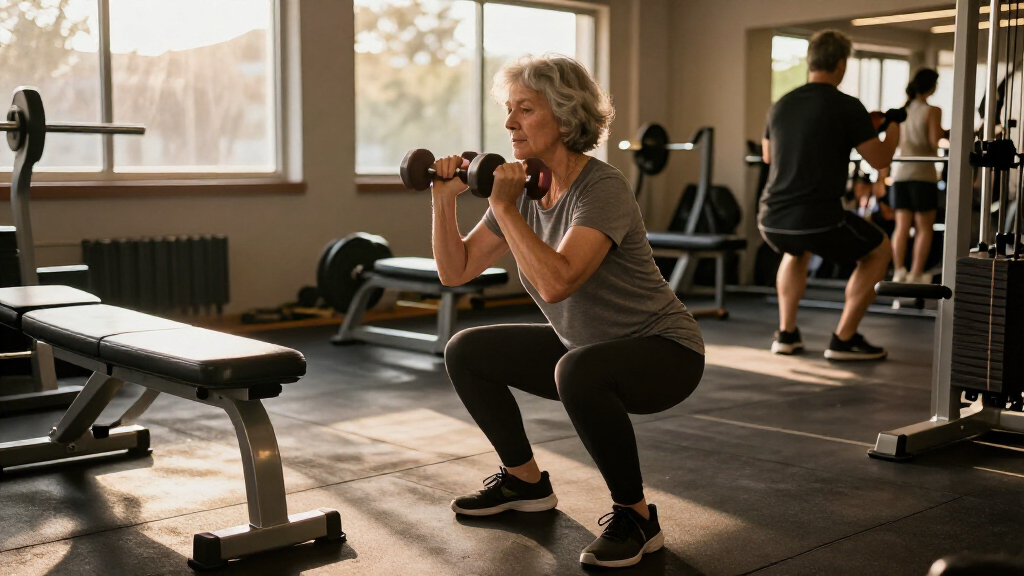
The Australian research team recruited adults from the Greater Brisbane region. Participants had an average age of 72 and an average body mass index of about 26 kg/m². They were assigned to high-intensity intervals, moderate-intensity exercise or a low-intensity comparison group, and completed three supervised 45-minute gym sessions per week for six months.
Researchers measured body composition at the start of the trial and again after three and six months using scans that estimate fat and lean tissue. The report says both HIIT and moderate exercise significantly reduced fat mass, with larger improvements than in the low-intensity group. The HIIT group reduced fat without the same decline in lean mass seen in the moderate group. Lean mass is not a direct measurement of muscle strength: it includes muscle as well as other tissues and water.
The report also describes reductions in visceral adipose tissue in both the high- and moderate-intensity groups. This fat is stored around internal organs. The researchers said further analysis was needed for the low-intensity results. The study did not establish that HIIT produced a large or clinically meaningful advantage over lower-intensity exercise.
Fat Loss Without Measured Lean-Mass Decline
The findings address a distinction that can matter with age: weight loss and improved body composition are not the same outcome. A person can lose weight while also losing lean tissue, whereas maintaining lean mass as fat declines may be a more favorable pattern. The study offers evidence that exercise intensity could be relevant to that balance for older adults.
Maintaining muscle is associated with the capacity to perform everyday tasks such as climbing stairs, rising from a chair and carrying objects. The researchers also discussed the potential relevance of abdominal fat to metabolic and cardiovascular health. However, this trial measured body-composition changes, not whether participants became stronger, more independent or less likely to develop disease. Its results should not be treated as proof of those outcomes.
The report characterizes the changes as relatively small and says their clinical importance was not clear after accounting for measurement uncertainty. The result is therefore a comparison among exercise groups, not evidence that HIIT is a guaranteed or uniquely effective route to fat loss for every older adult.
How the Six-Month Trial Worked
HIIT alternates brief periods of demanding effort with easier recovery periods. In this study, the hard intervals were described as exercise during which breathing became heavy and conversation was difficult. Participants trained in supervised gym sessions, so the trial tested a structured programme rather than unsupervised exercise at home.
Lead author and exercise physiologist Dr. Grace Rose said all three groups experienced modest fat loss, while only the HIIT group maintained lean muscle as measured. Co-author and University of the Sunshine Coast Associate Professor of Physiology Mia Schaumberg proposed that the greater muscular challenge of intervals may give the body a stronger signal to retain tissue. That is an explanation offered by the researchers, not a mechanism directly established by the body-composition results.
The scans used in the trial estimate lean tissue and fat distribution; they do not directly measure muscle strength. The distinction limits what can be inferred about practical effects. A change in lean-mass estimates does not necessarily mean an equivalent change in the strength or function needed for daily activities.
“We found that high, medium and low intensity exercises all led to modest fat loss but only HIIT retained lean muscle.”
— Dr. Grace Rose, lead author and exercise physiologist at the University of the Sunshine Coast
Limits of the Body-Composition Findings
The reported changes were modest, and their clinical importance remains uncertain. The source report cautions that differences were not clearly clinically meaningful when compared with lower-intensity exercise, particularly once measurement uncertainty was considered. It does not provide enough information here to determine how large the changes were for an individual participant.
The scans measured lean tissue rather than strength or physical performance, and the report does not establish that the participants’ everyday function improved. It also does not show whether the results would hold for older adults with chronic conditions, mobility limitations or different levels of fitness. The participants were described as healthy older adults, so the findings may not apply equally to everyone in that age group.
The report does not provide enough detail to determine which specific interval exercises participants performed, how intensity was adjusted for individuals, or how many participants completed every session. It also says further analysis is needed for low-intensity exercise and its effect on visceral fat. Those gaps limit comparisons beyond the main reported outcomes.
What Further Research Must Establish
The immediate next step is to interpret the results alongside the full study methods and data, including the size and variability of changes in each group. Further analysis of the low-intensity group’s visceral-fat results is also needed, according to the report. The available source does not identify a planned follow-up trial or a specific publication date for additional results.
Future research could test whether the body-composition differences translate into measurable changes in strength, mobility or health over a longer period, and whether similar effects occur in older adults with a wider range of health and fitness levels. Until those questions are answered, the study supports a limited conclusion: in this supervised six-month trial, HIIT reduced fat while measured lean mass was maintained, but the scale and practical significance of that difference remain uncertain.
Key Questions
What did the study find about HIIT and fat loss?
In a six-month trial, the HIIT group reduced fat mass while maintaining measured lean mass. The report describes the overall changes as modest.
Did moderate exercise also reduce fat?
Yes. The report says both moderate-intensity exercise and HIIT significantly reduced fat mass, with larger improvements than the low-intensity comparison group. Moderate exercise was also associated with a small decline in lean mass.
Does maintaining lean mass mean participants got stronger?
Not necessarily. The scans estimated lean tissue, not strength. Lean mass includes muscle along with other tissues and water, and the reported results do not establish improved physical function.
Were the benefits proven to be clinically meaningful?
No. The researchers described the changes as relatively small, and the report says differences were not clearly clinically meaningful compared with lower-intensity exercise after measurement uncertainty was considered.
Who took part in the trial?
The study included 123 healthy older adults from Greater Brisbane, with an average age of 72. They completed supervised gym sessions three times a week for six months.
Source: rss