
TL;DR
Fit&Well reported that Pilates instructor Madison DiSalvo recommended the dead bug, bird dog, bear plank and plank leg lift for training deep-core stability. The exercises use controlled limb movements while the torso and pelvis resist shifting; the report does not provide clinical evidence that this specific four-move routine improves health outcomes.
Pilates instructor Madison DiSalvo recommends four controlled movements—the dead bug, bird dog, bear plank and plank leg lift—as exercises for challenging deep-core stability. In a report by Fit&Well, DiSalvo said the moves ask people to keep their midsection steady while their arms or legs move, a principle that can also test balance and coordination.
The exercises and suggested volumes in the report are: dead bug, two to three sets of 10 to 15 repetitions on each side; bird dog, two to three sets of 10 to 15 on each side; bear plank, three to five holds of 20 to 30 seconds; and plank leg lift, two to three sets of 10 to 12 repetitions on each side. These are recommendations from the instructor as reported by Fit&Well, not a clinical training prescription for every reader.
For the dead bug, a person lies on their back with arms raised and knees bent, then lowers one arm and the opposite leg while trying to keep the lower back and pelvis from shifting. The bird dog begins on hands and knees; the person reaches one arm forward and the opposite leg behind, aiming to keep the hips level and back neutral. Both moves pair opposing limb movement with an effort to control the torso.
The bear plank starts on hands and knees. With toes tucked, the person lifts both knees about an inch from the floor and holds, keeping the back flat and neck long. For the plank leg lift, the person holds a straight-arm plank and lifts one leg at a time, trying to keep the pelvis level and avoid arching the lower back. The source advises moving with control and coordinating the movements with breathing.
How the Four Moves Challenge Stability
The routine’s main point is not simply to move the limbs, but to limit unwanted movement through the trunk while doing so. That stability demand gives readers a practical way to understand how these exercises are intended to train the torso, rather than treating a “deep core” workout as a list of abdominal movements.
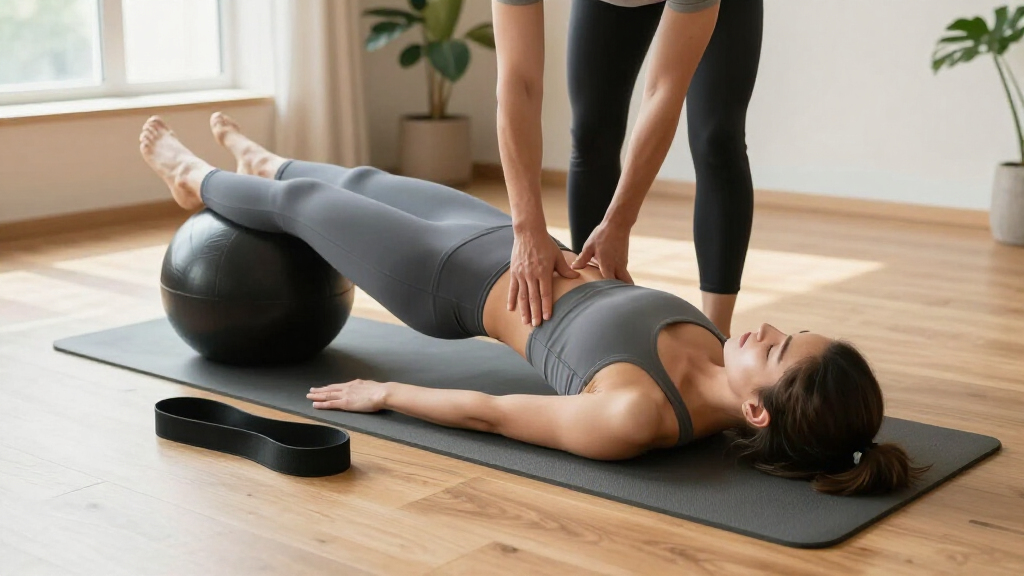
DiSalvo describes the transverse abdominis as a corset-like muscle below the ribs and says it is activated during the dead bug. Fit&Well also characterizes the bird dog as a balance and coordination challenge, while describing the dead bug as more demanding for deep-core muscles. Those comparisons are the report’s instructional framing; it does not cite a test comparing the exercises or quantify their effects.
For readers choosing a home exercise, the listed repetitions and holds provide a starting reference, while the emphasis on a neutral back and level pelvis signals when to reduce range or stop a repetition. People with pain, injury, pregnancy-related concerns or other health questions may need advice from a qualified clinician or exercise professional before following a routine.
Top picks for "pilat instructor exercis"
As an affiliate, we earn on qualifying purchases.
The Instructor’s Pilates Rationale
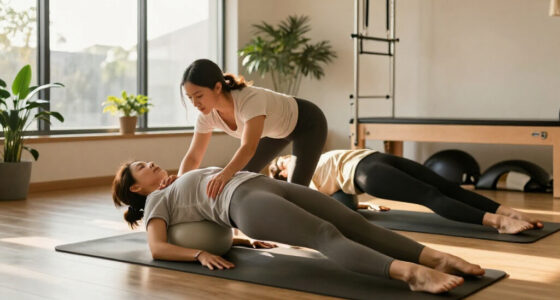
Fit&Well frames Pilates as a practice in which controlled limb movement is coordinated with breathing. DiSalvo, identified in the report as a Pilates instructor at STRONG Pilates Commack, says the method builds stability “from the inside out.” The four selected movements reflect that approach: each asks the person to coordinate breathing and limb motion while resisting movement through the torso.
The report does not present these as a newly developed workout or as a formal study. It is an exercise recommendation from an instructor, accompanied by basic setup directions, repetitions or hold times, and technique cues. Its core practical guidance is to keep the spine and pelvis controlled rather than letting the lower back arch or the hips rotate as the limbs move.
“It builds foundational stability from the inside out.”
— Madison DiSalvo, Pilates instructor at STRONG Pilates Commack, as quoted by Fit&Well
What the Exercise Report Does Not Establish
The source material does not state the report’s publication date, provide a study of the four exercises, or show that this exact sequence produces specific changes in strength, posture, balance or spinal health. Those outcomes should not be read as proven results of the routine. DiSalvo’s comments and the suggested exercise doses are attributed recommendations, not medical guidance tailored to individual conditions.
It is also unclear how often the routine should be performed, how long a person should follow it, or how to progress beyond the listed repetitions and holds. The report does not give modifications for people who find a movement too difficult or who experience discomfort. Readers should avoid pushing through pain and seek individualized guidance when needed.
Applying the Moves Safely
The report offers no announced follow-up study or additional milestone. For readers trying the exercises, the next step is to use the listed ranges as recommendations rather than requirements, prioritize controlled movement, and stop if form breaks down or pain develops. As the exercises become manageable, progression should be gradual; people new to exercise or managing an injury can ask a qualified instructor or health professional for guidance.
The practical test across all four movements is whether the limbs can move without the lower back arching, the pelvis tilting or the torso twisting. If that control is difficult, a reader can shorten the movement or choose a suitable easier variation with professional advice, rather than forcing the full range. The Fit&Well report does not specify a progression plan or claim that these four exercises are suitable for everyone.
Key Questions
Which four exercises did the instructor recommend?
Madison DiSalvo recommended the dead bug, bird dog, bear plank and plank leg lift in the Fit&Well report.
How many repetitions or holds does the report suggest?
It lists two to three sets of 10 to 15 repetitions per side for the dead bug and bird dog, three to five bear-plank holds of 20 to 30 seconds, and two to three sets of 10 to 12 plank leg lifts per side.
What technique is shared across the exercises?
Keep the torso controlled as the arms or legs move. The instructions emphasize a neutral back and level pelvis, avoiding lower-back arching, hip tilting or side-to-side weight shifts.
Does the report prove these exercises improve posture or spinal health?
No. The source describes an instructor’s recommendations and general rationale, but it does not provide research showing that this particular routine improves posture, spinal health or other outcomes.
Should someone exercise through discomfort?
No. Stop if pain develops or form cannot be maintained. People with injuries, health concerns or uncertainty about safe technique can seek advice from a qualified clinician or exercise professional.
Source: rss