Choosing a portable basketball hoop is a tradeoff between the amount you spend now and the kind of play the system can support over time. A budget hoop can make sense for a driveway where children shoot occasionally, practice is informal and the system needs to move or store away. A premium hoop is aimed at households that play often, want a sturdier feel and expect the hoop to remain a fixture for years.

Get sports gear delivered free with Prime
- Fast, free delivery on millions of items
- Prime Video, Amazon Music and more included
- Member-only deals all year

Spalding Momentous EZ Assembly Portable Adjustable Basketball Hoop
- ✔ Backboard: 54-inch acrylic H-frame
- ✔ Rim: 18-inch Pro Slam breakaway rim
- ✔ Height adjustment: 8–10 feet

IGL Portable Basketball Hoop with Adjustable Height and 40-Inch PC Backboard
- ✔ Backboard: 40 x 24 inches, polycarbonate
- ✔ Height range: 3–10 feet
- ✔ Main base capacity: 77 lb water or 100 lb sand
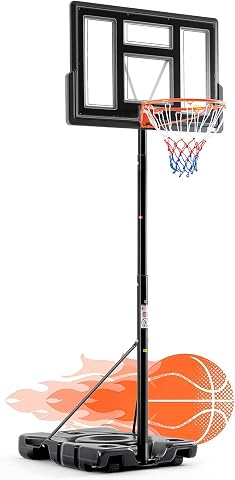
DUMOS Adjustable Portable Basketball Hoop, 44-Inch Backboard
- ✔ Backboard: 44 inches, shatterproof
- ✔ Height adjustment: 6.1–10 feet
- ✔ Rim: Shock-absorbing
These categories cover a wide range of products, so exact features vary by model. Still, the usual decision is clear: pay less for a lighter, simpler setup, or pay more for a heavier base, a larger or more substantial backboard, more useful adjustment and a structure designed to handle harder use. Choose the budget option when affordability and portability lead; choose premium when stability and regular play matter enough to justify the added cost.
At a Glance
| Criteria | Budget portable basketball hoop | Premium portable basketball hoop | Winner |
|---|---|---|---|
| Typical cost | Lower purchase cost; fewer premium materials or features are typical | Higher initial cost, often reflecting heavier construction or upgraded parts | A |
| Stability | Usually lighter, so movement and hard play can make it feel less steady | Heavier base and frame commonly give a more planted feel | B |
| Backboard and rebound | Often smaller or more flexible; adequate for casual shooting | Often larger or more substantial, which can improve play feel | B |
| Height adjustment | May offer adjustment, though the range or mechanism can be basic | May offer a broader range or smoother adjustment | B |
| Portability and setup | Generally easier to move, but still needs a filled base for play | Greater weight can make relocation and assembly harder | A |
| Durability and maintenance | More exposed to wear from weather and frequent use | Often better suited to frequent use, though care and weather protection still matter | B |
| Best use | Occasional driveway play and tighter budgets | Regular practice, family games and longer-term use | Depends |
Spalding Momentous EZ Assembly Portable Adjustable Basketball Hoop
The Spalding is the most substantial option here for players who want a near-court feel from a portable setup. Its 54-inch acrylic H-frame backboard is 10 inches wider than the DUMOS board and 14 inches wider than the IGL’s, giving players a larger target for bank shots. The 18-inch Pro Slam breakaway rim and arena-style padding reinforce its focus on serious outdoor play. Those features make it a stronger fit for teens and adults practicing at a full-height basket than either of the family-oriented alternatives.That focus comes with limits. Height adjustment starts at 8 feet, so the Spalding cannot lower as far as the DUMOS or IGL for young children learning to shoot. It is also listed at 117 pounds—far heavier than the IGL’s 40 pounds—so its portable floor-mount design should be understood as movable with effort, not effortless to relocate. The stated assembly time of 30 minutes or less is appealing, though assembly is still required. We would choose it when outdoor play and a larger board outweigh the need to move the hoop often or accommodate very young players.
Pros:
- Largest backboard in this comparison at 54 inches
- Acrylic H-frame board with arena-style padding
- 18-inch Pro Slam breakaway rim
- Adjusts from 8 to 10 feet and is designed for outdoor use
Cons:
- At 117 pounds, it is the heaviest and least convenient to reposition
- Cannot lower below 8 feet for beginner-height play
- Assembly is required even with the stated short assembly time
Best for: Older children, teens, and adults who want a large backboard and breakaway rim for outdoor practice at heights from 8 to 10 feet.
Not ideal for: Families with very young beginners who need a low basket, or anyone who expects to move a 117-pound hoop frequently.
Bottom line: For outdoor players who value a larger acrylic board and breakaway rim, the Spalding is the strongest fit, provided its weight and 8-foot minimum work for the household.
“For outdoor players who value a larger acrylic board and breakaway rim, the Spalding is the strongest fit, provided its weight and 8-foot minimum work for the household.”
IGL Portable Basketball Hoop with Adjustable Height and 40-Inch PC Backboard
When one hoop needs to serve players at very different stages, the IGL’s standout advantage is its 3-to-10-foot height range. It drops lower than the DUMOS, which starts at 6.1 feet, and well below the Spalding’s 8-foot minimum. That extra adjustment gives younger children a more reachable target while still allowing a full-height setting later. Its 40-by-24-inch shatterproof polycarbonate backboard is smaller than both competitors’ boards, so the IGL puts shared family use ahead of a broad shooting target.The 40-pound listed weight and built-in wheels make this model more manageable to reposition than the Spalding, and its dual fillable bases let owners add ballast to both the main and anchor bases. That setup is useful for a movable hoop, but buyers need to fill the bases with water or sand for added stability. The IGL is described for indoor and outdoor use, which adds flexibility, although the product still needs assembly and a suitable place to play. Compared with the DUMOS, it gives up four inches of backboard width in exchange for a lower starting height and a lighter listed weight.
Pros:
- Broad 3-to-10-foot adjustment range
- Shatterproof polycarbonate backboard
- Dual fillable bases provide two ballast points
- Built-in wheels and a 40-pound listed weight support repositioning
Cons:
- Its 40-by-24-inch backboard is smaller than the DUMOS and Spalding boards
- The bases need water or sand to add stability
- Assembly is required
Best for: Households with younger children or mixed-age players who need one portable hoop that can adjust from a low practice height up to 10 feet.
Not ideal for: Players who prioritize the largest possible backboard, or buyers who do not want to fill bases with water or sand.
Bottom line: The IGL is the most adaptable family pick because it reaches a low practice height and remains adjustable to 10 feet, though its smaller board is a clear compromise.
“The IGL is the most adaptable family pick because it reaches a low practice height and remains adjustable to 10 feet, though its smaller board is a clear compromise.”
DUMOS Adjustable Portable Basketball Hoop, 44-Inch Backboard
The DUMOS lands between the other two in both board size and adjustment range. Its 44-inch shatterproof backboard is larger than the IGL’s 40-inch board, while the hoop can lower to 6.1 feet—more accessible than the Spalding’s 8-foot starting point. For a household that wants a more generous target than the IGL offers but does not need a basket as low as 3 feet, this is the most balanced specification set in the group.A shock-absorbing rim adds a feature the other descriptions do not specify, and the fillable base plus two wheels support stability and relocation. Still, the base depends on water or sand for added ballast, just like the IGL’s, and the hoop requires assembly. Unlike the IGL, the DUMOS listing mentions included tools and instructions, which can make setup more straightforward. The available details do not state a product weight or base capacity, so we cannot compare its moving effort or ballast volume directly with the IGL and Spalding. It suits buyers seeking broad everyday utility, but it does not reach as low as the IGL or offer the Spalding’s larger acrylic board and breakaway rim.
Pros:
- 44-inch shatterproof backboard is larger than the IGL’s
- Adjusts from 6.1 to 10 feet
- Shock-absorbing rim
- Fillable base, two wheels, and assembly tools are included
Cons:
- Minimum height is higher than the IGL’s 3-foot setting
- Base needs water or sand for added stability
- Assembly is required
Best for: Families and casual players who want a middle-ground backboard size, adjustable height for children and adults, and tools included for assembly.
Not ideal for: Very young beginners who need a basket below 6.1 feet, or serious outdoor players seeking a 54-inch acrylic board and breakaway rim.
Bottom line: The DUMOS is a sensible middle choice for mixed-age casual play, trading the IGL’s extra-low setting and the Spalding’s larger board for a balanced combination of size and adjustment.
“The DUMOS is a sensible middle choice for mixed-age casual play, trading the IGL’s extra-low setting and the Spalding’s larger board for a balanced combination of size and adjustment.”
As an Amazon Associate we earn from qualifying purchases.
Key Differences
The largest difference is how each hoop behaves when play becomes energetic. A budget system can be perfectly usable for free throws, casual shooting and younger players, but a lighter frame and base may shift or vibrate more during rebounds or stronger contact. Premium systems commonly add weight and sturdier components, which can make them feel more settled. The gap matters most for frequent games; it matters less when the hoop is used for short, relaxed sessions.
Backboard feel and adjustment are the next reasons to spend more. A larger, more substantial board can provide a more convincing rebound and a familiar target, while a broader height range can serve children as they grow or accommodate different players. Those features are not guaranteed by a premium label, so compare the specifications of actual models. The added price pays off when the family uses those improvements often. If play is occasional, the lower-cost hoop is usually the better value.
Portability complicates the choice. Both types have a wheeled base and need proper filling before use, but a heavier premium hoop can be difficult to roll across uneven ground or move into storage. A lighter budget system is easier to reposition, though it may sacrifice steadiness. Decide where the hoop will live, how often it must move and who will handle it before choosing.
Detailed Comparison
Typical cost (Budget portable basketball hoop wins — major)
Budget wins by a major margin on initial outlay. It is the sensible starting point when the hoop is a trial purchase, use will be occasional or spending needs to stay low. A premium model costs more, and the higher price makes sense only if its sturdier feel or added features will see regular use. Paying extra for unused capacity does not improve value.
Premium usually wins by a major margin for active play. A heavier base and frame tend to feel more secure when players move quickly or rebounds hit hard. Budget hoops can serve casual shooting, but their lighter construction may wobble or shift more. Stability also depends on correct assembly, a properly filled base, level placement and following the maker’s instructions.
Premium usually wins by a moderate margin. More substantial boards and larger playing surfaces can make bank shots and rebounds feel more consistent. A budget board is often adequate for shooting practice, especially for newer or younger players. Check board size and material on each model: the category alone does not guarantee a particular rebound quality.
Premium often wins by a moderate margin, though this depends on the models. A broad adjustment range makes a hoop useful for children, teens and adults, while an easier mechanism encourages families to change the height. Some budget systems also adjust, but the range or mechanism can be more limited. Confirm the lowest and highest settings and how the maker expects height changes to be made.
Portability and setup (Budget portable basketball hoop wins — moderate)
Budget wins by a moderate margin for frequent relocation. Lower weight can make a budget system easier to roll and position, and a simpler build may be less demanding to assemble. Premium hoops can be cumbersome because the extra weight that improves steadiness also makes moving and setup harder. Neither type is effortless: a portable hoop still needs assembly, a filled base and suitable ground.
Premium usually wins by a moderate margin for frequent use. Heavier components and sturdier construction can better suit regular play, but no portable hoop is maintenance-free. Weather exposure, assembly quality and care affect both categories. Protecting the system as its maker recommends can extend its useful life. If it will stay outside year-round, inspect the materials and care guidance instead of relying on price as a durability guarantee.
Fit for casual or frequent play (major difference)
The winner depends on how often and how hard the hoop will be used. For occasional shooting, the budget model can deliver the needed function at a much lower price. For frequent practice and family games, premium features are more likely to matter every week. The practical test is not whether the premium hoop is more elaborate; it is whether the household will notice and use its advantages often enough to justify paying more.
Budget portable basketball hoop: Pros and Cons
Pros:
- Lower upfront cost
- Often lighter and easier to reposition
- Suits casual shooting and occasional family use
- A lower-commitment choice when the hoop is for a growing child or an uncertain routine
Cons:
- May feel less stable during energetic play
- Backboard and rebound can feel less substantial
- Adjustment options and mechanisms may be basic
- Frequent outdoor use may expose limitations sooner
Pros:
- Heavier construction often feels more stable
- A more substantial backboard can improve the play experience
- Adjustment features may suit a wider range of ages and heights
- Often a better match for regular practice and games
Cons:
- Higher initial cost
- Extra weight can make moving and storage harder
- Assembly may take more effort
- The added features offer poor value if the hoop is used only occasionally
Who Should Choose What
Choose Budget portable basketball hoop if:
- You want a low-cost hoop for casual driveway shooting.
- You expect to move the system regularly and prefer a lighter setup.
- You are buying for younger players or trying out a new activity before committing to a more expensive system.
- Your play is mostly shooting practice rather than frequent competitive games.
Choose Premium portable basketball hoop if:
- Your household plays several times a week and stability matters.
- Players take stronger shots or want a more substantial rebound feel.
- Different ages or skill levels will use the hoop and a wider adjustment range is useful.
- You expect to keep the hoop for years and will use its upgraded features regularly.
Skip both if: Neither category fits if you need a permanently fixed, highly stable installation for intensive play. Compare in-ground systems or other fixed options suited to that use.
Value for Money
The budget hoop is better value for occasional play because its lower price buys the basic experience without charging for features that may sit unused. For a family that shoots now and then, a more expensive base or backboard is unlikely to change how often the hoop gets used. The budget choice is also reasonable when easy repositioning matters more than a particularly planted feel.
Pay more for premium when regular use makes the difference noticeable: a steadier setup, a more substantial board or a useful adjustment range can improve every session. That can justify the initial cost for a household that plays often and plans to keep the hoop. Compare specific models and their care requirements before buying, since premium pricing alone does not prove that a particular system is durable or better suited to your driveway.
Final Verdict
For most households with occasional driveway play, choose the budget portable hoop: it covers casual shooting at a lower cost and is often easier to move. Choose premium if the hoop will see regular practice or games, and its added stability, backboard or adjustment features match the way your household plays. The biggest deciding factor is frequency: when use is frequent, paying more is easier to justify; when use is sporadic, keep the savings. If intense play and maximum steadiness are the goal, skip both portable categories and look at a fixed system.
Frequently Asked Questions
Is a premium portable basketball hoop worth the extra cost?
It can be if your household plays often and will use its added stability, backboard quality or adjustment features. For occasional shooting, the budget option is usually better value.
Are budget portable hoops stable enough for children?
They can work for casual play when assembled and used according to the maker’s directions, with the base properly filled and placed on suitable ground. Stability varies by model, so check the product details and supervise play as appropriate.
Can a portable hoop be moved easily?
Many have wheels, but moving one still takes effort, particularly after the base is filled. Budget models are often lighter and easier to reposition; heavier premium models can be harder to roll and store.
What should I compare before buying a portable hoop?
Check the hoop’s height range, backboard size and material, base and frame construction, assembly requirements, movement guidance and care instructions. Those details reveal more about fit than the budget or premium label alone.