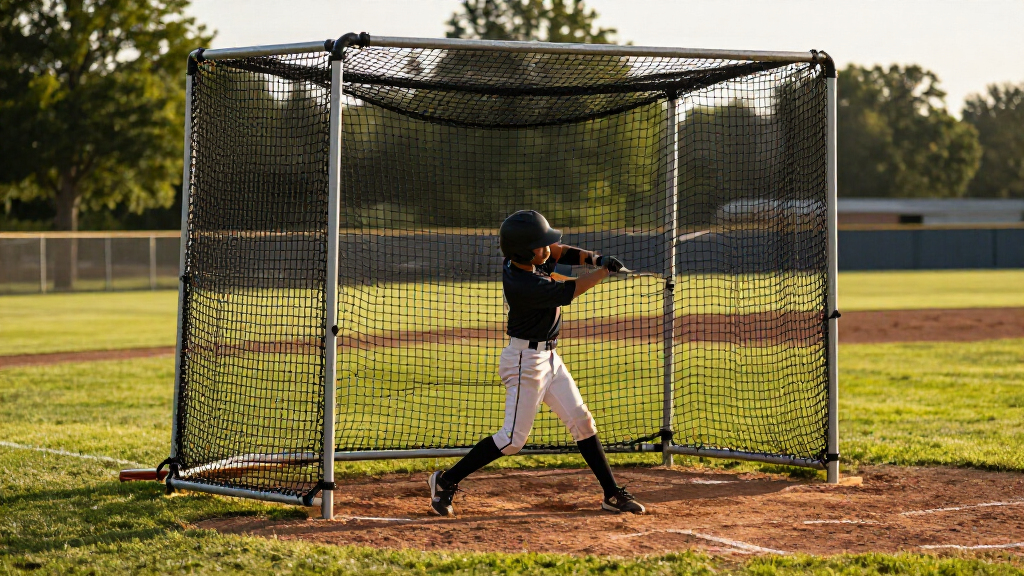
The best portable batting cage overall in this roundup is the Sturdum Baseball and Softball Batting Cage, which stands out for offering a choice of 22- or 30-foot lengths. The Skywalker Sports 40-Foot Cage is the longer practice option, while the OZIS Inflatable Batting Cage takes a different approach for buyers who value a quick-deploy enclosure. The main tradeoffs are practice length, setup and storage demands, and how fully the net contains balls. A longer cage may give hitters more room to work, but it also needs more clear space and can be harder to manage. Read on for the full breakdown and guidance on matching a cage to your available space and training routine.
Complete the kit


Key Takeaways
- Length changes the shortlist: the Sturdum offers 22- or 30-foot configurations, the Skywalker extends to 40 feet, and the 24-foot DHUAFDD and DPFHDCIC sit between those choices.
- Several options share the same listed footprint: the Portable Baseball and Softball Batting Cage Net, Apex Sports, Shopsource, IDEATRY, and Vertura are each listed at 22 x 12 x 8 feet, so buyers should compare their setup details and included components rather than rely on dimensions alone.
- The OZIS inflatable design is a different kind of portable: its blower-based structure may appeal to buyers prioritizing deployment style, but it is not a direct substitute for a conventional framed cage.
- Enclosure details separate similar-sized cages: the DHUAFDD listing calls out reinforced netting, while the ORIENGEAR is described as fully enclosed and measures 30 x 13 x 9 feet; verify opening and containment details against your practice routine.
- Portability does not remove space demands: the 40-foot Skywalker and 30-foot ORIENGEAR need more room than the 22-foot class, while a compact model may be easier to site but offer less cage length.
| Sturdum Baseball and Softball Batting Cage, 22 or 30 ft |  | Best for Pitching-Machine Flexibility | Brand: Sturdum | Sports: Baseball and softball | Listed dimensions: 30 × 12 × 8 ft | VIEW LATEST PRICE | See Our Full Breakdown |
| Portable Baseball and Softball Batting Cage Net, 22 x 12 x 8 ft |  | Best for Fast, Tool-Free Setup | Brand: ZivPlay | Dimensions: 22 × 12 × 8 ft | Net material: Three-ply stretchable polyester | VIEW LATEST PRICE | See Our Full Breakdown |
| Skywalker Sports 40-Foot Competitive Baseball and Softball Batting Cage |  | Best for Long-Lane Training | Length: 40 ft | Overhead clearance: 10 ft | Item dimensions: 480 × 144 × 120 in | VIEW LATEST PRICE | See Our Full Breakdown |
| OZIS Inflatable Batting Cage with Blower |  | Best Inflatable for Multi-Sport Practice | Dimensions: 19.7 × 11.5 × 9.8 ft | Material: Polyester netting with Oxford cloth seams | Blower: 110 V, 60 Hz | VIEW LATEST PRICE | See Our Full Breakdown |
| Apex Sports Portable Baseball and Softball Batting Cage, 22 x 12 x 8 ft |  | Best for Soft-Rebound Practice | Dimensions: 22 × 12 × 8 ft | Suitable sports: Baseball and softball | Netting: Three-ply stretchable polyester, 1.25 in | VIEW LATEST PRICE | See Our Full Breakdown |
| Shopsource Portable Baseball and Softball Batting Cage, 22 x 12 x 8 Feet |  | Best for Indoor-Outdoor Flexibility | Dimensions: 22 x 12 x 8 feet | Brand: Shopsource | Net material: Polyester | VIEW LATEST PRICE | See Our Full Breakdown |
| DHUAFDD 24 ft Backyard Batting Cage with Reinforced Netting |  | Best for Wind-Anchored Backyard Practice | Dimensions: 24 x 10 x 10 ft | Net material: 4-ply polyester | Frame material: Fiberglass | VIEW LATEST PRICE | See Our Full Breakdown |
| IDEATRY Portable Baseball and Softball Batting Cage, 22 x 12 x 8 ft |  | Best for Spare-Pole Preparedness | Dimensions: 22 x 12 x 8 ft | Net material: Four-strand high-strength polyethylene | Mesh size: 1.25 inches | VIEW LATEST PRICE | See Our Full Breakdown |
| Vertura Portable Baseball and Softball Batting Cage, 22 x 12 x 8 ft |  | Best for Multi-Sport Field Practice | Dimensions: 22 x 12 x 8 ft | Netting: 3-ply blue Oxford | Frame: 14 mm fiberglass poles | VIEW LATEST PRICE | See Our Full Breakdown |
| DPFHDCIC 24 ft Baseball and Softball Batting Cage |  | Best for Longer Enclosed Practice | Dimensions: 288 x 120 x 120 inches (24 x 10 x 10 ft) | Netting: 4-ply polyester | Pitching port: 7 x 7 inches | VIEW LATEST PRICE | See Our Full Breakdown |
| ORIENGEAR Fully Enclosed Baseball and Softball Batting Cage, 30 x 13 x 9 ft |  | Best for Anchored Backyard Setups | Dimensions: 30 ft L × 13 ft W × 9 ft H | Brand: ORIENGEAR | Net material: Polyester | VIEW LATEST PRICE | See Our Full Breakdown |
| VEVOR Portable Baseball and Softball Batting Cage |  | Best for Longer Practice Space | Dimensions: 40.0 × 12.1 × 10.0 ft | Net material: Polyester, 4-ply reinforced mesh | Edge fabric: 600D nylon | VIEW LATEST PRICE | See Our Full Breakdown |
| portable batting cage | Dimensions | Warranty | Net material |
|---|---|---|---|
| Sturdum Baseball and Softball | — | 1 year | — |
| Portable Baseball and Softball | 22 × 12 × 8 ft | — | Three-ply stretchable polyester |
| Skywalker Sports 40-Foot Compe | — | 3 years on frame; 1 year on other parts | — |
| OZIS Inflatable Batting Cage w | 19.7 × 11.5 × 9.8 ft | — | — |
| Apex Sports Portable Baseball | 22 × 12 × 8 ft | — | — |
| Shopsource Portable Baseball a | 22 x 12 x 8 feet | 1 year | Polyester |
| DHUAFDD 24 ft Backyard Batting | 24 x 10 x 10 ft | One year | 4-ply polyester |
| IDEATRY Portable Baseball and | 22 x 12 x 8 ft | 1 year | Four-strand high-strength polyethylene |
| Vertura Portable Baseball and | 22 x 12 x 8 ft | 1 year | — |
| DPFHDCIC 24 ft Baseball and So | 288 x 120 x 120 inches (24 x 10 x 10 ft) | 1 year | — |
| ORIENGEAR Fully Enclosed Baseb | 30 ft L × 13 ft W × 9 ft H | 1 year | Polyester |
| VEVOR Portable Baseball and So | 40.0 × 12.1 × 10.0 ft | — | Polyester, 4-ply reinforced mesh |
More Details on Our Top Picks
Sturdum Baseball and Softball Batting Cage, 22 or 30 ft
The Sturdum stands out for buyers who want a portable cage that can accommodate a pitching machine without giving up a removable door for pitcher-led drills. Its large machine opening makes it a more flexible practice setup than the OZIS inflatable cage, whose listed details do not specify a pitching-machine port. The included carrying bag, anchors, ground nails, and elastic rope support moving and securing the cage for indoor or outdoor use. Its 1-inch mesh is a clearly stated net specification, though the listing does not explain its durability under repeated high-impact use. The main drawback is sizing ambiguity: the title lists 22- or 30-foot options, while the dimensions specify 30 × 12 × 8 feet. I’d confirm the selected length before planning a practice area.
Pros:- Large opening designed to accommodate most pitching machines
- Removable door supports pitcher-led practice
- Carrying bag and included anchoring gear support transport and setup
- 1-inch mesh specification is provided
Cons:- Listing gives both 22- and 30-foot lengths but specifies dimensions only for the 30-foot version
- Net durability under repeated hard-hit balls is not described
Best for: Players or families who need a removable door and a large pitching-machine opening, and can verify which cage length they are ordering.
Not ideal for: Buyers with a fixed-size practice area who need unambiguous dimensions before purchase, or those seeking a stated net-layer construction.
- Brand:Sturdum
- Sports:Baseball and softball
- Listed dimensions:30 × 12 × 8 ft
- Other listed length:22 ft
- Mesh size:1 inch
- Materials:Polyester, fiberglass, and iron
- Color:Black
- Warranty:1 year
Our verdict“Choose the Sturdum if machine access and a removable door matter most, but verify the cage length before setting aside space.”
Portable Baseball and Softball Batting Cage Net, 22 x 12 x 8 ft
The ZivPlay cage earns its place for buyers who want a 22-foot practice enclosure that can go together without tools in under 30 minutes. Its three-ply stretchable polyester net is intended to soften rebounds and resist tearing, while the 20 × 40-inch pitching-machine hole gives a more clearly specified access point than the Sturdum’s broadly described large opening. A detachable door also makes pitcher-led sessions possible. The tradeoff is footprint: this cage still needs a full 22 × 12 × 8 feet, so it is not a compact backyard solution. At 13.29 kg, it is portable but not weightless, and the product details provide no wind-testing or long-term durability information. I’d favor it over the Skywalker for simpler setup, but not for a larger, more rigid framed practice station.
Pros:- Tool-free assembly is listed as taking under 30 minutes
- Three-ply stretchable polyester net is designed for softer rebounds and tear resistance
- 20 × 40-inch pitching-machine opening has a specified size
- Includes eight ropes and ground pegs for securing the cage
Cons:- Requires a 22 × 12 × 8-foot setup area
- No long-term durability or wind-test details are provided
- Package weight of 13.29 kg may be a consideration for frequent transport
Best for: Families and coaches with a level 22 × 12-foot practice area who want tool-free setup and clearly sized machine access.
Not ideal for: Players seeking a long 40-foot training lane, or buyers who need documented wind performance and long-term durability information.
- Brand:ZivPlay
- Dimensions:22 × 12 × 8 ft
- Net material:Three-ply stretchable polyester
- Frame material:Fiberglass
- Pole diameter:12.7 mm
- Pitching-machine opening:20 × 40 in
- Included supports:8 ropes and ground pegs
- Setup:Tool-free; under 30 minutes
- Package weight:13.29 kg
Our verdict“Pick the ZivPlay for a machine-ready 22-foot cage that prioritizes straightforward setup over a longer training lane.”
Skywalker Sports 40-Foot Competitive Baseball and Softball Batting Cage
Among these five options, the Skywalker is the clear choice for buyers who need room to work through longer batting sequences: its 40-foot length exceeds the 22-foot ZivPlay and Apex cages by a wide margin. A steel frame, rust-resistant treatment, UV-treated netting, and angled leg braces point to a more substantial semi-permanent setup than the lighter portable cages. That extra structure comes with a real portability cost: the package weighs 99 pounds, and the assembled footprint is substantial. The frame and net also suit a dedicated training space better than frequent trips between locations. Its three-year frame warranty is longer than the one-year coverage listed for the Sturdum, though other parts have one year. I’d choose it for a spacious facility or backyard, not for quick solo setup or tight storage.
Pros:- 40-foot length supports a longer batting lane than the 22-foot portable models
- Rust-resistant steel frame and UV-treated netting are specified
- Angled leg braces add structural support
- Frame warranty is three years
Cons:- 99-pound package weight makes transport and setup less convenient
- Requires substantial space for a 40-foot cage
- Warranty coverage for parts other than the frame is one year
Best for: Teams, coaches, or serious backyard hitters with a permanent 40-foot area and help available to move and assemble a heavier frame.
Not ideal for: Families who need a cage that one person can carry and set up frequently, or anyone with less than 40 feet of clear space.
- Length:40 ft
- Overhead clearance:10 ft
- Item dimensions:480 × 144 × 120 in
- Package dimensions:62 × 13 × 7 in
- Package weight:99 lb
- Frame:Rust-resistant steel
- Netting:UV-treated
- Sports:Baseball and softball
- Warranty:3 years on frame; 1 year on other parts
Our verdict“Choose the Skywalker for a roomy, more structured training lane when length and frame support matter more than easy transport.”
OZIS Inflatable Batting Cage with Blower
The OZIS takes a different approach to portability: instead of assembling a pole-and-net frame like the Apex, it uses an inflatable structure with a blower. That makes it the most distinct pick here for buyers who want an enclosed space that can serve baseball, softball, and tennis practice. Its 19.7 × 11.5 × 9.8-foot footprint is shorter and slightly narrower than the 22 × 12 × 8-foot cages, though the listed height is greater. Mesh sides support airflow, and the package includes stakes, sandbags, and an accessories set. The compromise is dependence on a 110 V power supply while inflating, plus less detail about setup time and machine access than the ZivPlay or Sturdum provide. Balls and other training equipment are not included.
Pros:- Supports baseball, softball, and tennis practice
- Inflatable design differs from pole-and-stake cages such as the Apex
- Mesh sides promote airflow
- Includes blower, stakes, sandbags, and an accessories set
Cons:- Blower requires a 110 V power supply
- Balls and other training accessories are not included
- Pitching-machine access and setup time are not specified
Best for: Households or training groups that want an enclosed practice area for baseball, softball, and tennis and have access to 110 V power.
Not ideal for: Players who need a specified pitching-machine port, frequent remote practice without power, or a cage with a clearly documented pole-frame setup.
- Dimensions:19.7 × 11.5 × 9.8 ft
- Material:Polyester netting with Oxford cloth seams
- Blower:110 V, 60 Hz
- Recommended uses:Baseball, softball, and tennis
- Included components:Inflatable cage, outer bag, blower, and accessories set
- Included anchoring:Stakes and sandbags
- Color:Black
- Brand:OZIS
Our verdict“Choose the OZIS if multi-sport use and an inflatable enclosure suit your practice space and you can provide power.”
Apex Sports Portable Baseball and Softball Batting Cage, 22 x 12 x 8 ft
The Apex is a focused choice for hitters who want a conventional 22 × 12 × 8-foot cage with netting designed to give as balls strike it. Its stretchable three-ply polyester construction is intended to soften rebounds, and the 3.5 × 2-foot pitching-machine opening provides a clear access point for machine or screen use. Compared with the Sturdum, Apex specifies its opening dimensions, while the Sturdum offers a removable door and lists more than one possible cage length. The fiberglass poles, eight plastic stakes, supporting nets, and carry bag make the Apex portable, but this remains a pole-and-stake assembly rather than an instant enclosure. Buyers should also note that the supplied information does not state setup time, pole diameter, or durability testing. It suits routine hitting practice better than buyers prioritizing detailed assembly guidance.
Pros:- Three-ply stretchable netting is designed to soften ball rebounds
- Pitching-machine opening measures 3.5 × 2 ft
- Includes fiberglass poles, supporting nets, and eight stakes
- Carry bag supports transport and storage
Cons:- Requires assembly with poles and stakes
- Setup time and durability testing are not stated
- No removable door is listed
Best for: Baseball and softball hitters who want a portable, specified-size machine opening and netting designed for softer ball rebounds.
Not ideal for: Buyers who want tool-free setup details, a removable door for pitcher-led sessions, or a longer cage than 22 feet.
- Dimensions:22 × 12 × 8 ft
- Suitable sports:Baseball and softball
- Netting:Three-ply stretchable polyester, 1.25 in
- Pitching-machine opening:3.5 × 2 ft
- Pole material:Fiberglass
- Pole diameter:12.7 mm
- Included accessories:8 plastic stakes, supporting nets, and carry bag
Our verdict“Pick the Apex for portable 22-foot hitting practice when soft-rebound netting and a clearly sized machine opening are the priorities.”
Shopsource Portable Baseball and Softball Batting Cage, 22 x 12 x 8 Feet
The Shopsource cage is a practical pick for players who may move practice between a backyard, park, or suitable indoor space. Its 22 x 12 x 8-foot footprint is the same as the IDEATRY and Vertura cages, while the removable door and large opening make entry and pitching-machine access more convenient. The included carrying bag supports transport, and the 1-inch mesh is intended for repeated baseball or softball practice. Unlike the taller 24-foot DHUAFDD and DPFHDCIC cages, this model is shorter and may be easier to fit into some practice areas. The tradeoff is that it still needs assembly and anchoring, and the supplied details do not specify pole material or setup time. I’d choose it for flexible practice locations, not for buyers seeking the most documented frame or net construction.
Pros:- Carrying bag supports transport between practice locations
- Removable door and large opening provide practical access
- Listed for indoor and outdoor use
- 1-inch mesh is specified for the netting
Cons:- Assembly and anchoring are required
- Pole material and setup time are not specified
- Its 8-foot height is shorter than the 10-foot DHUAFDD and DPFHDCIC cages
Best for: Families and coaches who want a bagged cage they can move between a backyard, park, and an appropriately sized indoor practice space.
Not ideal for: Buyers who need verified frame details, a published setup time, or a taller 24-foot enclosure for more expansive practice.
- Dimensions:22 x 12 x 8 feet
- Brand:Shopsource
- Net material:Polyester
- Mesh size:1 inch
- Color:Black
- Recommended uses:Baseball, softball
- Included components:Batting cage, carrying bag
- Warranty:1 year
Our verdict“Choose the Shopsource if moving a medium-size cage between suitable indoor and outdoor spaces matters more than a taller enclosure or detailed frame specifications.”
DHUAFDD 24 ft Backyard Batting Cage with Reinforced Netting
The DHUAFDD 24-foot cage is the stronger fit for outdoor setups where secure anchoring and a taller enclosure matter. Its 24 x 10 x 10-foot dimensions provide more length and height than the 22 x 12 x 8-foot Shopsource, IDEATRY, and Vertura cages, while four-ply polyester netting, stakes, and wind ropes support a more fully equipped backyard installation. The 7 x 7-inch pitching port and double-sided zipper door make practice access straightforward, and a repair patch plus an extra pole add useful field-repair options. The tradeoff is a more involved setup: the stated assembly time is about 30 minutes with at least two people. Its fiberglass poles also may not suit buyers seeking a metal frame. I’d favor it over the DPFHDCIC when the pitching port and listed outdoor anchoring kit are central priorities.
Pros:- 24 x 10 x 10-foot enclosure offers more height and length than the 22-foot options
- Four-ply polyester netting is specified
- Includes ground stakes, wind ropes, and U-shaped stakes
- Pitching port, double-sided zipper door, repair patch, and spare pole support practice and upkeep
Cons:- Setup calls for two or more people
- Fiberglass poles may be less durable than a metal frame
- Outdoor use limits flexibility compared with the indoor-outdoor Shopsource
Best for: Households or coaches with a dedicated outdoor practice area, a helper for setup, and a need for a taller cage with included wind anchoring.
Not ideal for: Solo installers or buyers who need a quick one-person setup, a metal frame, or a cage intended for indoor use.
- Dimensions:24 x 10 x 10 ft
- Net material:4-ply polyester
- Frame material:Fiberglass
- Pole diameter:12.7 mm
- Pitching port:7 x 7 in
- Door height:5.2 ft
- Setup time and installers:About 30 minutes; 2 or more people
- Warranty:One year
Our verdict“Pick the DHUAFDD for a roomy, anchored outdoor cage when you can assemble it with another person and do not require a metal frame.”
IDEATRY Portable Baseball and Softball Batting Cage, 22 x 12 x 8 ft
The IDEATRY cage suits buyers who want a familiar backyard-sized setup with a spare frame part ready if a pole is damaged. Its 22 x 12 x 8-foot dimensions match the Shopsource and Vertura, but the kit specifies a four-strand, 1.25-inch polyethylene net, fiberglass poles, and a spare pole. That extra component is a useful distinction from the Shopsource, whose product details do not list a spare frame piece. Ground pegs, U-shaped anchors, ropes, and a pitching-machine opening round out the kit, while the stated setup time is about 30 minutes. At 27.5 pounds, it remains portable as a complete kit, though carrying it does not remove the work of assembling and anchoring a full-size cage. Buyers with limited room should skip it; its footprint still requires a substantial practice area.
Pros:- Spare fiberglass pole is included
- Pitching-machine opening supports machine-fed practice
- Four-strand polyethylene net and 1.25-inch mesh are specified
- Ground pegs, anchors, ropes, and storage bag come with the kit
Cons:- Requires a large practice area
- About 30 minutes of setup still involves assembling and anchoring the full cage
- At 27.5 pounds, it is portable but not a lightweight, instant-deploy option
Best for: Baseball or softball households that want a standard backyard cage, a pitching-machine opening, and an extra fiberglass pole for potential repairs.
Not ideal for: Players with a small yard or anyone seeking a cage that can be erected without assembling and anchoring a full frame.
- Dimensions:22 x 12 x 8 ft
- Net material:Four-strand high-strength polyethylene
- Mesh size:1.25 inches
- Frame:12.7 mm fiberglass poles
- Weight:27.5 lb
- Setup time:About 30 minutes
- Included components:Main net, four fiberglass rods (three required, one spare), storage bag, ground pegs, U-shaped anchors, hooks, ropes, and rope connectors
- Warranty:1 year
Our verdict“Choose the IDEATRY if you want a 22-foot cage with a pitching-machine opening and spare pole, and have room for a full setup.”
Vertura Portable Baseball and Softball Batting Cage, 22 x 12 x 8 ft
The Vertura cage stands out for buyers who want to use one enclosure for baseball, softball, cricket, and other field practice. Its 22 x 12 x 8-foot footprint matches the IDEATRY and Shopsource, but it specifies 14 mm fiberglass poles, a 3-ply Oxford net, and a 3.3 x 1.6-foot pitching-machine opening. Metal anchors and braided ground ropes are included, giving its anchoring kit a different mix from the IDEATRY’s pegs and U-shaped anchors. The detachable door and carry bag support access and transport. The main compromise is setup: allow about an hour and two to three people, longer and more labor-intensive than the IDEATRY’s stated 30 minutes with no installer count given. Its blue net may also be a less discreet choice for some yards.
Pros:- Listed for baseball, softball, cricket, and other sports
- Large pitching-machine opening and detachable door
- Metal anchors and 16-strand braided ground ropes are included
- Carry bag supports transport and storage
Cons:- Assembly takes about an hour with two to three people
- At 28 pounds, it takes some effort to carry
- Blue net may be more visually prominent than the black alternatives
Best for: Multi-sport families or coaches who want a portable outdoor enclosure with a pitching-machine opening and can spare a small setup crew.
Not ideal for: Solo users, buyers who need the shortest stated setup time, or anyone wanting a black net that blends more quietly into a yard.
- Dimensions:22 x 12 x 8 ft
- Netting:3-ply blue Oxford
- Frame:14 mm fiberglass poles
- Pitching-machine opening:3.3 x 1.6 ft
- Ground ropes:16-strand braided
- Weight:28 lb
- Setup:About one hour; 2–3 people
- Warranty:1 year
Our verdict“The Vertura makes sense for multi-sport users who value its specified pitching opening and anchoring kit more than quick assembly.”
DPFHDCIC 24 ft Baseball and Softball Batting Cage
The DPFHDCIC 24-foot cage is a fit for players who want more room to hit and pitch inside an enclosure without stepping up to a much longer cage such as the Skywalker Sports 40-foot model. Its 24 x 10 x 10-foot listed dimensions provide more length and height than the 22 x 12 x 8-foot IDEATRY and Vertura, and the four-ply polyester net is designed to help contain impact. A 7 x 7-inch pitching port, zipper door, stakes, wind ropes, repair patch, and carry bag make this a fairly complete outdoor kit. The listing describes setup as tool-free, although poles still need assembly and the cage needs anchoring. One detail deserves care: the title references several cage lengths, but the supplied specifications identify this package as 24 feet.
Pros:- 24 x 10 x 10-foot size provides more length and height than the 22-foot options
- Four-ply polyester netting is specified
- Pitching port and zipper door support enclosed practice
- Includes stakes, wind ropes, repair patch, extra pole, and carry bag
Cons:- Supplied specifications identify a 24-foot size despite the title referencing several lengths
- Tool-free setup still requires assembly and anchoring
- Fiberglass pole sets may not appeal to buyers looking for a metal frame
Best for: Baseball and softball players who want a longer, taller outdoor cage with a pitching port, included anchoring pieces, and a carry bag.
Not ideal for: Buyers who need a clearly verified alternative length, a metal frame, or a cage that can be set up alone without anchoring.
- Dimensions:288 x 120 x 120 inches (24 x 10 x 10 ft)
- Netting:4-ply polyester
- Pitching port:7 x 7 inches
- Door height:5.2 ft
- Materials:Metal, polyester
- Package weight:15.45 kg
- Included components:Batting cage net, fiberglass pole sets, extra fiberglass pole, ground stakes, wind ropes, U-shaped pins, repair net patch, carry bag, user manual
- Warranty:1 year
Our verdict“Choose the DPFHDCIC for a longer, taller cage with a pitching port and repair accessories, provided the 24-foot size is the one you need.”
ORIENGEAR Fully Enclosed Baseball and Softball Batting Cage, 30 x 13 x 9 ft
The ORIENGEAR’s 30-foot enclosed layout gives hitters room for batting and pitching practice while helping keep balls within the cage. Its polyester net has 1.25-inch mesh, with Oxford cloth reinforcement at the seams; ground stakes and windproof ropes are included to secure the frame outdoors. Compared with the VEVOR Portable Baseball and Softball Batting Cage, it is shorter and narrower, but its listed 13-foot width offers a little more lateral space. The button-linked side provides convenient access without making the enclosure feel like a fixed facility. The tradeoff is portability: at 40.8 pounds, it still needs a suitable setup area and dependable anchoring. Concrete or indoor floors may require added weights, and the product description gives conflicting dimensions, so I would confirm measurements before planning a tight space.
Pros:- Fully enclosed net helps contain balls during batting and pitching practice.
- Listed 30 × 13 × 9 ft dimensions provide a roomy practice area.
- Ground stakes and windproof ropes are included for outdoor anchoring.
- Button-linked side provides access to the enclosure.
Cons:- Concrete and indoor installations may need added weights or other suitable anchors.
- The product description contains conflicting dimensions, making space planning less certain.
- At 40.8 lb, it is not as easy to move around as a compact net.
Best for: Backyard or school users who want an enclosed cage for both baseball and softball and can stake it securely outdoors.
Not ideal for: Buyers setting up on concrete or indoor flooring without separate weights, or anyone who needs fully consistent dimensions before choosing a confined space.
- Dimensions:30 ft L × 13 ft W × 9 ft H
- Brand:ORIENGEAR
- Net material:Polyester
- Mesh size:1.25 in
- Seam material:Oxford cloth
- Pole material:Fiberglass
- Weight:40.8 lb
- Included components:Iron pole, fiberglass pole, polyester mesh
- Warranty:1 year
Our verdict“Choose the ORIENGEAR if you want a substantial enclosed backyard cage and have a secure outdoor anchoring option.”
VEVOR Portable Baseball and Softball Batting Cage
With a listed length of 40 feet, the VEVOR is the longer choice here for buyers who want room to work on hitting and pitching inside one enclosed setup. Its 4-ply reinforced polyester mesh and 600D nylon edge fabric are aimed at handling repeated impacts, while a zippered entry and pitching machine opening make practice access more practical. Compared with the ORIENGEAR 30 x 13 x 9 ft cage, VEVOR adds ten feet of length but is slightly narrower at 12.1 feet, so buyers should prioritize available run length over lateral room. A storage bag supports packing it away between sessions, but this is not a leave-it-out-all-season structure: the listing advises against extended outdoor exposure. Assembly is designed for two people, which also limits how conveniently one person can set it up alone.
Pros:- 40-foot length gives hitters more practice space than the ORIENGEAR 30-foot cage.
- 4-ply reinforced polyester mesh and 600D nylon edge fabric are designed for repeated impacts.
- Zippered entry and pitching machine opening support different practice setups.
- Storage bag makes packing and transport more manageable.
Cons:- Requires two people for assembly, so solo setup is not the intended use.
- Not recommended for long-term outdoor exposure.
- Its 40-foot length calls for more clear yard or facility space than shorter cages.
Best for: Coaches and families with room for a 40-foot setup who want an enclosed cage with a pitching machine opening and can assemble it with a helper.
Not ideal for: Solo users, buyers with limited yard length, or anyone seeking a cage that can remain outdoors for long periods.
- Dimensions:40.0 × 12.1 × 10.0 ft
- Net material:Polyester, 4-ply reinforced mesh
- Edge fabric:600D nylon
- Pole material:Fiberglass
- Entry:Zippered entry with removable door
- Practice access:Pitching machine opening
- Assembly:Designed for two people
- Included accessory:Storage bag
Our verdict“Pick the VEVOR if you need a longer enclosed practice lane and can assemble it with a partner and store it between sessions.”

How We Picked
I compared these portable batting cages by how well their listed size, design, and enclosure address real practice needs. The main criteria were usable cage length and width, the amount of space required around the structure, setup and storage implications, netting or enclosure details, and whether the design suits backyard, team, or occasional use. I also treated portability as more than a product label: buyers need to know whether a cage can fit their site and routine, not just whether it is marketed as portable.
The ranking favors options with a clear use case and useful tradeoffs. Sturdum ranks first for its choice of lengths; the Skywalker follows for buyers who specifically need a longer cage, while the OZIS earns a distinct spot for its inflatable format. The remaining options are grouped by dimensions, stated construction details, and enclosure style rather than by assumptions about unlisted materials or performance. Where listings share a footprint or provide limited distinguishing information, I avoid treating them as interchangeable and recommend checking the exact included parts and setup requirements before buying.
Factors to Consider When Choosing Portable Batting Cages
Choosing a cage is a site-planning decision as much as a net choice. Before comparing product labels, I would map the practice area, decide what kind of hitting will happen, and think through how often the cage must be assembled or moved. These broader checks can prevent a cage that looks right on paper from becoming difficult to use.
Measure the Whole Setup Area, Not Just the Cage
Listed dimensions describe the cage, not necessarily the clear area needed to assemble it, anchor it, or move around it. Measure the intended footprint and check for fences, branches, overhead lines, sheds, and neighboring property before choosing a longer model. Leave room for the hitter, feeder or pitching setup, and a safe path to retrieve balls. A 40-foot cage can be a better fit for longer practice sessions, but only if the site accommodates its length without forcing a cramped setup. If your usable area is uncertain, mark the proposed dimensions on the ground before ordering.
Match Cage Length to the Practice Routine
A longer cage can provide more room for a hitter to track a pitch and work through drills, but it is not automatically the right choice for every backyard. Shorter cages may suit tee work, soft toss, or constrained sites, depending on the user’s age and training setup. Think about how balls will be delivered and how far the hitter needs to stand from the net, then compare that routine with the listed dimensions. Buyers often focus on total length and overlook width and height, which can affect swing clearance and ball containment. If multiple players will use the cage, prioritize a footprint that accommodates their needs without crowding the practice area.
Check What Portable Means for Setup and Storage
Portable designs can still require time, help, and dedicated storage space. Before purchasing, check whether the listing explains assembly, anchoring, disassembly, and what components are included; do not assume poles, stakes, or a carry bag are supplied. A cage that stays assembled in one spot has different portability needs from one that must be moved after every session. Inflatable designs also bring a blower into the setup equation, so buyers should plan for power access and storage of the blower as well as the enclosure. If setup friction is likely to limit how often the cage gets used, choose the design whose routine fits your household.
Judge Netting and Enclosure for Your Ball Use
Netting is not only about stopping a ball; its coverage and openings affect where missed hits can go. Review whether the cage is fully enclosed, how entry and exit work, and whether the design appears suited to the balls and hitting intensity planned. A listing that specifically mentions reinforced netting, such as the DHUAFDD, gives buyers a detail to investigate, but the phrase alone does not answer questions about material, seams, or care. Fully enclosed designs may help contain balls during practice, though they can be less convenient to enter or set up. If the cage will be used near people, windows, or property boundaries, containment deserves more weight than a small difference in length.
Plan for Weather, Anchoring, and Maintenance
Outdoor placement adds demands that product dimensions do not show. Wind can put stress on a large netted structure, so check the manufacturer’s anchoring instructions and avoid leaving a cage exposed when conditions exceed its guidance. Wet conditions and prolonged sun can also affect netting and frame components over time; follow care instructions and store the cage when appropriate. A larger enclosure can catch more wind and take longer to dry or pack away than a smaller one. Buyers who need a semi-permanent backyard setup should weigh anchoring and upkeep just as carefully as buyers who plan to move the cage often.
Compare Included Components Before Deciding
Products with matching listed dimensions may still differ in frame pieces, net configuration, anchors, assembly hardware, or storage accessories. Check the complete package contents and any separate equipment needed for your intended setup. This is especially useful when comparing the five listed 22 x 12 x 8-foot options, since their shared measurements alone do not establish that they perform or assemble alike. Look for clear product information on replacement parts and care instructions, too. If those details are absent, ask the seller before purchase rather than assuming another cage’s accessories will fit.
Frequently Asked Questions
How much backyard space should I reserve for a portable batting cage?
Start with the listed cage dimensions, then add working room for assembly, anchoring, entry, and the hitter’s practice setup. Check the entire footprint for branches, fences, structures, and overhead obstructions, rather than measuring only the ground length. The 22-foot and 24-foot options may suit sites where a 30- or 40-foot model cannot fit, but width and height still need checking. Mark the dimensions on the ground before buying to reveal pinch points. Follow the manufacturer’s siting and anchoring instructions once you have selected a model.
Is a 22-foot cage enough for a youth player?
It can be enough for some youth drills, but the right length depends on the hitter’s age, how balls are delivered, and the distance needed between the player and the feeder or pitching setup. Tee work and soft toss may place different demands on the available length than live pitching practice. The 22-foot class is easier to fit into many yards than the Skywalker’s 40-foot design, but a smaller footprint is not useful if it crowds the drill. Confirm the cage’s usable dimensions and practice recommendations before deciding. If the player will outgrow the setup soon, compare the longer options against your actual available space.
Should I choose an inflatable batting cage or a framed cage?
The OZIS inflatable model and conventional framed cages solve portability in different ways. An inflatable format may suit buyers who value its deployment style, but it requires planning for the blower and power access. A framed cage may be a better fit for a setup that stays in one place or for buyers who prefer a structure built from frame components. Compare assembly instructions, anchoring, storage, and what is included rather than relying on the word portable. If you expect to move the cage frequently, verify the complete pack-down routine before purchase.
Can I leave a portable batting cage set up outdoors?
That depends on the cage’s instructions, anchoring system, materials, and local weather. A netted structure can catch wind, so leaving it up without following the maker’s guidance may create safety and damage risks. Check instructions for wind limits, anchoring, wet-weather care, and whether the cage should be taken down when not in use. Larger models such as the 40-foot Skywalker or 30-foot ORIENGEAR deserve particular attention because their greater span can complicate placement and storage. If frequent take-down is part of your plan, factor that effort into the purchase decision.
What should I verify when several cages have the same listed dimensions?
Matching dimensions do not confirm matching construction or package contents. Compare the frame design, net coverage, access openings, anchoring hardware, assembly steps, and replacement-part information for each listing. For the 22 x 12 x 8-foot options in this roundup, those details may matter more than the shared footprint when choosing among them. Also check whether the dimensions refer to the full exterior or usable interior space. If a key specification is missing, get clarification rather than filling the gap with assumptions.
Conclusion
For most buyers who want flexibility in footprint, I recommend the Sturdum Baseball and Softball Batting Cage as the best overall pick, thanks to its 22- or 30-foot choices. The best value direction is a 22 x 12 x 8-foot model that fits your site and clearly lists the components you need; compare the Portable Net, Apex Sports, Shopsource, IDEATRY, and Vertura listings carefully rather than assuming their shared size makes them equivalent. For a premium-sized practice area, the 40-foot Skywalker is the standout for buyers who have room for its longer layout, while the 30 x 13 x 9-foot ORIENGEAR suits those prioritizing a fully enclosed format. Beginners with limited space should start by comparing the shorter configurations and confirming assembly details; the Sturdum at 22 feet is a practical place to begin. For specific needs, consider the OZIS inflatable design for its distinct deployment style or the DHUAFDD if reinforced netting is a priority. Choose by site, practice routine, and setup tolerance, not length alone.